Most sci-fi games come back to three places: the inside of a ship or station, the space outside it, and the screen the player reads it all through. This guide plans those in pixel art, from the rooms a ship needs to walls and doors that join, machines that move, a red alert, space beyond the hull and a HUD that looks like ship hardware, with the Godot 4 steps for each.
Pick the view first
The view decides which art fits, so choose it before anything else.
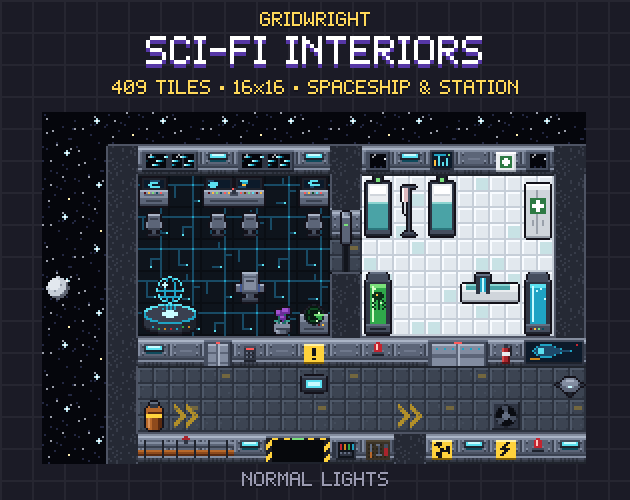
- Top-down suits RPGs, survival games and derelict-ship horror. Sci-Fi Interiors has 409 pieces on a 16x16 grid, the same grid and view as Gridwright's Interiors and Top-Down Tileset.
- Isometric suits colony sims and base builders. Isometric Sci-Fi Colony has 305 pieces on a 32x16 grid, with full walls and cut-away walls so players can see inside.
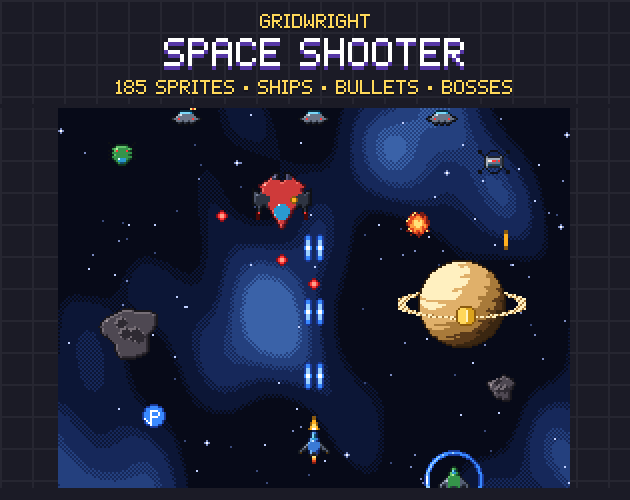
- A vertical shooter needs ships, bullets and scrolling space. Space Shooter has 185 sprites on a 16x16 grid.
Many sci-fi games use two views, one for walking the ship and one for flying it. Keep the pixel size the same in both and the switch still feels like one game.
The rooms a ship needs
Plan the ship as a corridor with rooms off it, each with a job the player can name. This list covers most stories, with the props Sci-Fi Interiors has for each:
- Bridge: captain chairs and crew seats facing 4 ways, consoles, a holo table and a radar.
- Engineering: a reactor, a generator, power cells, a coolant tank and server racks.
- Medbay: med beds, healing pods, specimen tanks and a scanner.
- Crew quarters: beds, a bunk bed, lockers, a mess table and a food dispenser.
- Cargo and hydroponics: crates, canisters, a tool cart, a drone and planters in 3 growth stages.
- Armoury: a weapon locker, floor turrets facing 4 ways and force fields.
- Cryo bay and transport: cryo pods that are empty, occupied or open, and a teleporter.
End the corridor at an airlock, the one door that leads outside, and give it a frame no other door uses.
Walls, floors and doors
Ship walls turn corners all the time, so draw them as an autotile. Sci-Fi Interiors' walls are 47-tile autotiles, 188 tiles in four finishes: fleet hull panels, white lab panels, military plating with hazard stripes and a rusted derelict hull. Every wall file's name and tiles.json carry its neighbour bitmask, so the walls can be wired to any engine.
In Godot, put the walls in a terrain set with the Match Corners and Sides mode, one of the three modes the TileSets page lists. Create a physics layer before adding collision shapes, since the page says tiles need one first. The 32 floors come in 4 variants each, and mixing them breaks up a long corridor.
Doors make a ship feel lived in. The pack has 16 door frames: a front door, a double door and an airlock for walls that run across the screen, and a side door for walls that run up and down. Every door opens in 4 frames while its light turns from red to green. Make each door a small scene with an AnimatedSprite2D and a collision shape: play the opening, switch the shape off when animation_finished arrives, and play_backwards to close.
Machines that move
A ship where nothing moves looks switched off. Sci-Fi Interiors has 31 animated pieces with 99 frames, among them windows, screens, beacons, consoles, the holo table, the reactor, pods, force fields and the teleporter. Pieces that only loop can be animated tiles in the TileSet: TileSetAtlasSource stores the frame count, the columns, each frame's duration and an animation mode. With TILE_ANIMATION_MODE_RANDOM_START_TIMES each copy starts at a random time, so a row of consoles doesn't blink in unison.
Red alert and lighting
Red alert is the cheapest drama a ship has: the same rooms, darker and red. Sci-Fi Interiors has lamps in normal and red-alert light, a rotating beacon and an alert sign, and no baked shadows, so your own lights go on clean tiles. In Godot:
- Add a CanvasModulate. The 2D lights page says it darkens the scene with a base colour; set a dark red during the alert.
- Give each lamp a PointLight2D. Its texture sets the light's size, energy and color its strength and tint, and the default Add blend suits most cases.
- Swap the lamps for their red-alert versions and start the beacons.
- If the light looks too smooth, snap it to the grid. The page says 2D light is computed at the viewport's resolution and that Nearest filtering won't fix that, and it suggests a shader that snaps the light to a pixel grid. More in 2D lighting for pixel art games.
Space outside the hull
Windows sell the setting. Sci-Fi Interiors has windows with stars or a planet, animated warp-speed windows, and four starfield tiles that mix freely, with a ringed planet and a moon, for the space beyond the hull. For flight, Space Shooter has far stars, a nebula and near stars as 256x256 backgrounds that tile both ways, in blue and purple, plus 3 planets.
Scroll them with Parallax2D. Its autoscroll moves a layer by itself in pixels per second, repeat_size repeats each child's texture at that distance, and scroll_scale moves far layers less than near ones, which reads as depth. For planets that turn, Pixel Planets has 62 planets and moons drawn at 32, 64 and 128 px, each making one full turn per loop.
A HUD that looks like ship hardware
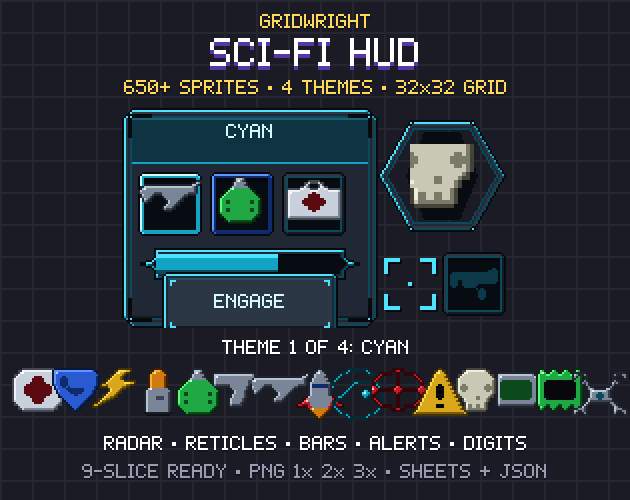
Sci-Fi HUD has 669 sprites on a 32x32 grid in four themes, cyan, green, amber and red, each with its own corner shape and glow and the same file names, so a whole UI changes by swapping one folder. That also makes the red alert easy: switch the HUD to red along with the lights.
- Bars: shield, energy, heat, ammo and health fills. A TextureProgressBar draws texture_under, texture_progress and texture_over, and nine_patch_stretch lets the frame take any width.
- Radar: a round frame with range rings and an 8-frame sweep that goes over the frame and under the blips, so add the nodes in that order.
- Reticles: twelve, including a 64x64 sniper scope and a 4-frame lock-on.
- Cooldowns: the pack's 8-frame sweep, or a TextureProgressBar with fill_mode set to Clockwise, which the reference says turns it into a radial bar.
- Comms: a window with a portrait frame. Pixel Portraits' sci-fi cast, such as the Captain, the Engineer and the Android, fits its 76x76 frame.
Ships for the space part
Space Shooter's 4 player ships come in 3 colours with bank-left, centre and bank-right frames and engine flames, against 10 small enemies at 16x16, 4 large at 32x32 and 2 bosses at 64x64. For a game where players design ships or meet many factions, Modular Spaceships has 66 parts in 4 factions that snap on a 16x16 grid, each also damaged. The Ship Builder puts them together in the browser and exports the ship with a 4-frame flame sheet.
A sci-fi checklist
- One view per mode, at the same pixel size.
- Rooms with jobs the player can name, off one corridor.
- Walls as autotiles with collision, doors as small scenes.
- Machines that start their loops at random times.
- A red alert made of the lights, the lamps and the HUD theme.
- Space that scrolls in layers at different speeds.
Sci-Fi Interiors, Sci-Fi HUD, Space Shooter, Isometric Sci-Fi Colony, Pixel Planets and Modular Spaceships are on Gridwright, each bought once with a free sample to try first.
Gridwright packs can be used in commercial games; you may not resell the files themselves. Packs released from October 28, 2026 ask for a credit: “Art by Gridwright” with a link, and each pack's LICENSE.txt says which applies. Pixel Planets and Modular Spaceships ask for one; Sci-Fi Interiors, Sci-Fi HUD and Space Shooter came out before that date, so for them a credit is optional. More in can I use game assets in a commercial game.