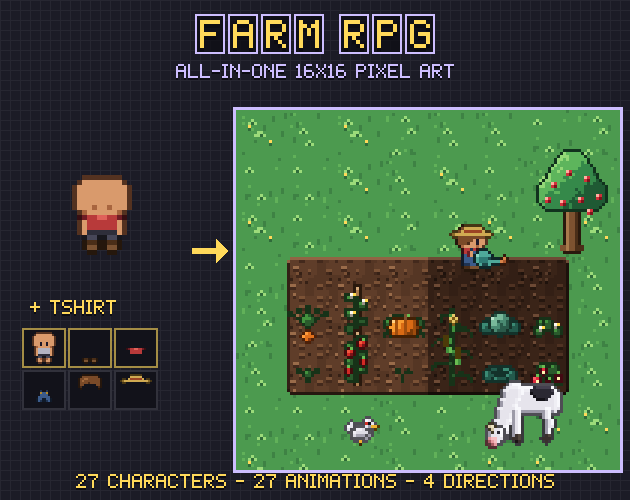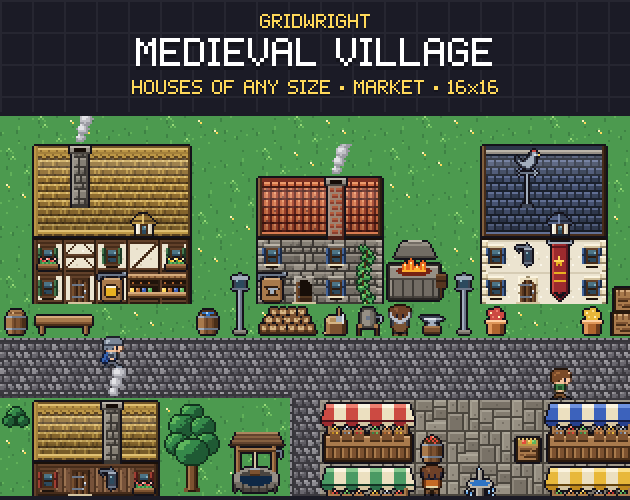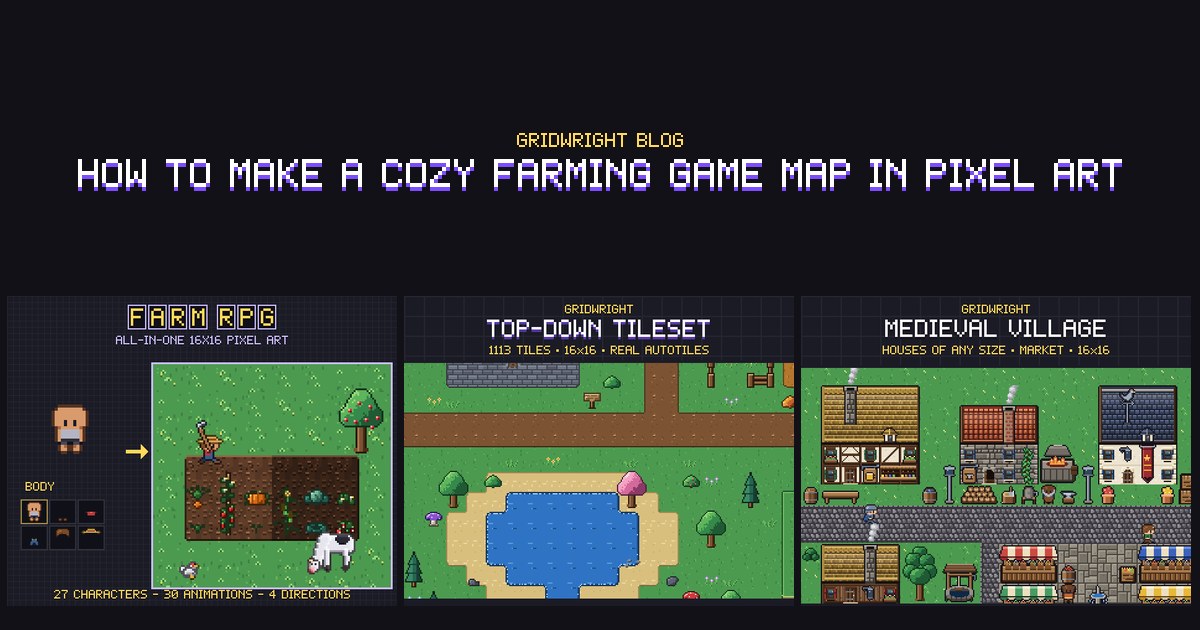
A farming game's map is the place the player sees every in-game day. They wake up in it, walk the same path to the field each morning and judge each new season by how it looks. The farmer and the crops are covered in how to make a farming RPG in pixel art. This guide is about the map itself, from its size and zones to the seasons and the layers in Godot 4.
Size and zones: from the door outwards
Pick the base resolution and the tile size first. Godot's guide to multiple resolutions calls 640x360 a good baseline for pixel art, since it scales to 1280x720, 1920x1080, 2560x1440 and 3840x2160 with integer scaling. With 16x16 tiles that view shows 40 tiles across and 22.5 down, so a farm of 64x48 tiles is 1.6 screens wide and just over 2 tall. At 80 pixels a second the player walks across it in about 13 seconds.
Then lay the farm out in zones, ordered by how often the player needs them. What they use every day goes closest to the door.
- The house: near the top, its door facing down the screen. In Gridwright Farm, whose buildings Farm RPG uses, the barn is 64x64 and the chicken coop 48x48, so they take 4x4 and 3x3 tiles.
- The yard: the shipping bin and the well between the door and the field, on ground nobody tills by accident.
- The fields: the largest flat area, all one ground type. Start the player with a small cleared plot and cover the rest in debris to clear; Farm RPG includes debris for this.
- The water: a pond near the fields for the watering can and for fishing, and a river that closes one side.
- The wild edge: trees, rocks and cliffs, where Animals & Pets can add foxes, squirrels, deer and birds in four directions.
- The exits: one path to town, and later others to the beach or the mine.
The field needs a tillable mask
Players till in any shape, so the game has to know which cells allow a hoe. In Godot 4 that is a custom data layer. The TileSet docs describe custom data as information specific to your game, stored per tile, so every placed copy of a tile shares it. Add a boolean named tillable and switch it on for the grass and dirt; paths, cobbles and floors stay off. A patch that must stay untouched, such as the yard, then needs a ground tile of its own with the flag off.
When the hoe lands, local_to_map gives the cell, get_cell_tile_data returns its TileData and get_custom_data reads the flag, as in the example in the TileMapLayer reference. If the flag is on, set_cells_terrain_connect paints soil into the cell. The reference says this call may update neighbouring tiles to make correct transitions, and that it needs every terrain combination set up, which a full 47-tile set has.
Farm RPG ships dry and watered soil as 47-tile autotiles that join without a seam, and its Godot 4 TileSet has terrains for the soil, the path, the animated water, the ice and two floors. Watering a cell then means painting the watered terrain over it.
Paths and water
Paths show the way without arrows. Run Farm RPG's dirt path autotile from the door to the field, the water and every exit, and keep it off the field itself, where the player makes their own lanes between crops.
- Make the road to town 2 tiles wide and side paths 1.
- End every path at something: a gate, the bin, the pond, a sign.
- Leave tillable off on path tiles, or a hoe swung near the door digs up the road.
- Keep tall trees off the lower side of a path: with Y sort their crowns hide a player walking behind them.
Farm RPG's water is a 47-tile autotile with an animated shore in 3 frames, deep water drawn on top of it, lily pads, reeds, stepping stones, and a ripple, a splash and fish shadows for the fishing. Keep the deep water a few tiles in from the shore and the reeds at the edges, so the open middle shows where to cast.
In the TileSet, create a physics layer first (Godot's TileSet page says tiles can't have collision without one), give the water tiles collision shapes, and mark them in a custom data layer named water, so the watering can and the rod can check the cell the player faces.
The town edge and the map's borders
Let the farm change before the player reaches town: the dirt path turns to cobbles, a wall lines the road and a signpost names it. Medieval Village has a 47-tile cobblestone road autotile that lies on grass or snow, a dry-stone wall and a wooden palisade with 16 joins each, a gate, a signpost and market stalls, on the same 16x16 grid and view as Gridwright Farm.
Close the other edges with things players accept as walls: a tree line, a river, a cliff. The Top-Down Tileset has raised plateaus in grass, sand and snow, walled on the edges that face down the screen, and a wood fence and a stone wall that join on all four sides. Then set Camera2D's limit_left, limit_right, limit_top and limit_bottom. Godot's reference says the camera stops moving when it reaches them.
Seasons: same shapes, new tiles
Keep the layout and change only the tiles, so collision, paths and the tillable mask stay where they were.
- Grass: Farm RPG's comes in spring, summer, autumn and winter, with painted tufts, flowers, fallen leaves and snow.
- Trees: 8 fruit trees in blossom, fruit and autumn looks, bare in winter, plus an oak in four seasons, a pine and a snowy pine.
- Water: ice with the same shapes as the water, so winter keeps the shore line.
- Town: Medieval Village's roofs also come snow-covered, and its cottage, inn, smithy, shop, townhouse and hall each have a winter version.
The swap is simplest when each season's tiles sit at the same atlas coordinates in their own atlas: loop over get_used_cells and call set_cell with the new source id and the old coordinates. Farm RPG's catalog.json lists every sprite's season. Winter-only details such as snow drifts can sit on a layer whose enabled property stays off the rest of the year; the reference says a disabled TileMapLayer also turns off its rendering and collision.
Layers in Godot: one job each
Godot's guide to TileMaps advises several TileMapLayer nodes when appropriate, and each layer holds one tile per cell. On a farm map:
- Ground: grass, dirt and sand painted with terrains. It carries the tillable flag.
- Water: its own layer with collision, so the winter ice swap touches nothing else.
- Soil: empty when the game starts. The game writes tilled soil here, and erase_cell turns a plot back into the grass still on the ground layer below.
- Detail: tufts, flowers and pebbles with no collision, kept off the field.
- Objects: fences, crops, trees and buildings under one Node2D with Y Sort Enabled, together with the player.
With y_sort_enabled on, Godot draws nodes with a higher Y position in front of those with a lower one. Each tile's Y Sort Origin, an offset in pixels, works only when Y Sort Enabled is on for its TileMapLayer under CanvasItem > Ordering. Set it so a tall crop on a 16x32 frame sorts from its base, and the farmer can walk behind the corn.
Readable for hours
- Give grass, path and tilled soil clearly different values, with watered soil darker still, so the state of the field reads from across the screen.
- Leave the field plain. Tufts and flowers on tillable cells compete with the crops and vanish under the first hoe.
- Mix packs that share one light direction and one outline rule. Gridwright Farm keeps both, on the same grid and in the same style as the Top-Down Tileset.
- Judge the map in the running game at its real scale.
For ground no pack has, such as a mossy yard, the Autotile Builder turns a 3x3 island into a 47-tile set with a seam check, and its full edition writes a Godot 4 TileSet and a Tiled wang set. When to paint with terrains and when to place a tile yourself is covered in autotile vs hand-placed tiles.
Farm RPG, the Top-Down Tileset, Medieval Village and Animals & Pets are on Gridwright, each bought once with a free sample to try first.
Gridwright packs can be used in commercial games; you may not resell the files themselves. Packs released from October 28, 2026 ask for a credit: “Art by Gridwright” with a link. Farm RPG came out after that date, so credit it; the Top-Down Tileset, Medieval Village and Animals & Pets are older, and for them a credit is optional. More in can I use game assets in a commercial game.