A tower defense map has one job: the player has to read it in a second. Where do the enemies come from, where do they go, and where can I build? Isometric art makes that harder. The path has to join itself around corners on a diamond grid, the towers have to stand on the same grid as the ground, and an enemy walking behind a tower has to disappear behind it, not draw on top. Most ground packs give you nice grass and nothing else. This guide goes through the pieces a tower defense map needs, from the path to the waves, and how to wire them up in Godot 4.
The parts of a tower defense map
- A path from the spawn point to the goal, in a material that stands out from the ground.
- Build spots beside the path that look different from the ground you can't build on.
- Blockers: trees, rocks, water and walls that shape the route and stop building.
- Towers and traps in a few clear types, readable at a glance.
- Enemies with different shapes and sizes, so a mixed wave is easy to read.
- A goal to protect, such as a gate, a keep or a camp.
- Hit, death and spawn animations, so every shot has a result on screen.
The path: a track that joins itself
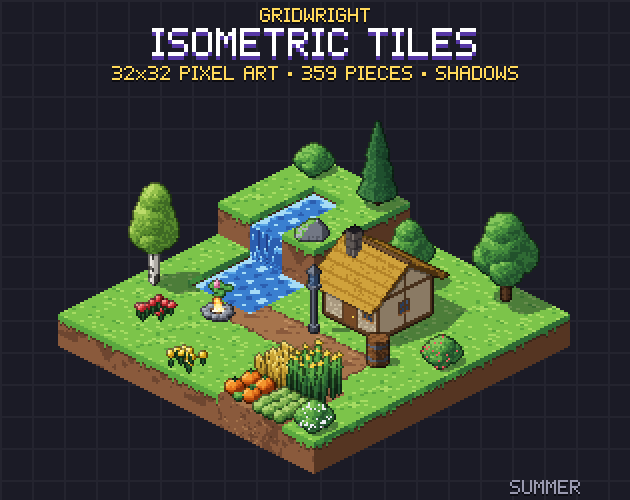
The path is the first thing to paint and the last thing to change. On a diamond grid it needs corner pieces that join in every direction. Isometric Tiles has a dirt path, a cobblestone road and a sand path with 15 corner pieces each, transparent outside the road, so they lie on any ground block. Isometric Castle & Siege adds a rutted mud track with 15 corner pieces and courtyard flagstones. A mud track across grass, or a cobblestone road through a courtyard, keeps the route clear even when the screen fills with towers and effects.
Height makes a map more interesting without making it harder to read. Isometric Tiles has ramps in 6 materials up towards all 4 corners and stone and wooden stairs in 4 directions, so the path can climb a hill and the towers on top get a better view in the player's eyes. Keep ramps on straight stretches of the path: the pack's ramps are straight only, with no corner ramps.
Moving enemies along the path in Godot 4
There are two common ways to move enemies. For a fixed route, draw a Path2D over the painted road and give every enemy a PathFollow2D. Godot's docs describe PathFollow2D as a point sampler for a Path2D: its progress is the distance along the path in pixels, and progress_ratio is the same position from 0.0 at the first point to 1.0 at the last. Raise progress by the enemy's speed every frame, and when progress_ratio reaches 1.0 the enemy has reached the goal. Its rotates option is on by default; with 8-direction sprites, turn it off and pick the sprite's direction from the way it is moving instead.
For a maze map, where the player's towers block the way, use AStarGrid2D. It has isometric cell shapes (CELL_SHAPE_ISOMETRIC_RIGHT and CELL_SHAPE_ISOMETRIC_DOWN), set_point_solid marks a cell as blocked, and get_id_path returns the route from start to end. Call update() after changing the grid's region or cell size, and before you mark the solid cells: the docs note that update() clears all point data, the solid cells included. When a new tower would block the last route, get_id_path comes back empty, and that is the moment to refuse the build.
Build spots and blockers
Players should never have to guess where a tower can go. Give the build spots their own look: flagstone or stone blocks in a grass field, or a raised half block. Isometric Tiles has ground in 11 materials with full blocks, half blocks and flat floors, so build spots can be one material and everything else another. Blockers shape the route and fill the space: oaks, pines, rocks, bushes and reeds from Isometric Tiles, its animated water and lava, and its wooden fence, low stone wall and hedge with 16 joins each. A moat of animated water around the goal tells the player where the last stand happens.
Towers, walls and traps
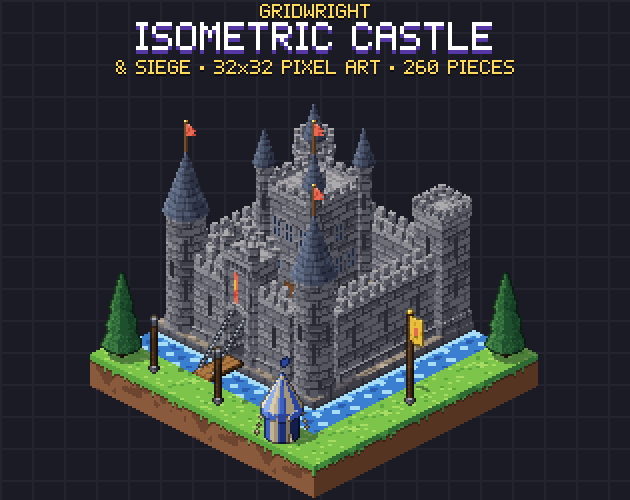
A tower defense game needs a few tower types that look different from each other at once. Isometric Castle & Siege gives you round and square towers in grey stone, sandstone and dark basalt, with battlements or under a slate roof, plus a ruined tower and a wooden watchtower. Its siege engines map well to tower types: a catapult that fires in 4 frames and faces both ways for splash damage, a ballista for single targets, and a trebuchet for long range. One way to show upgrades is by material: the wooden watchtower first, then a grey stone tower, then sandstone, then basalt.
Walls and traps fill in the rest. The curtain walls come in the three finishes with 16 joins each, battlements on every open side and a wall walk, and there are spiked barricades, boiling oil, torch posts and catapult stones. For the goal, a gatehouse whose portcullis rises over 4 frames, or a keep with four corner turrets, gives the enemies something to reach. Each standing piece has its own shadow sprite with the same anchor, so shadows can be drawn at any opacity or left off.
Enemy waves that read at a glance
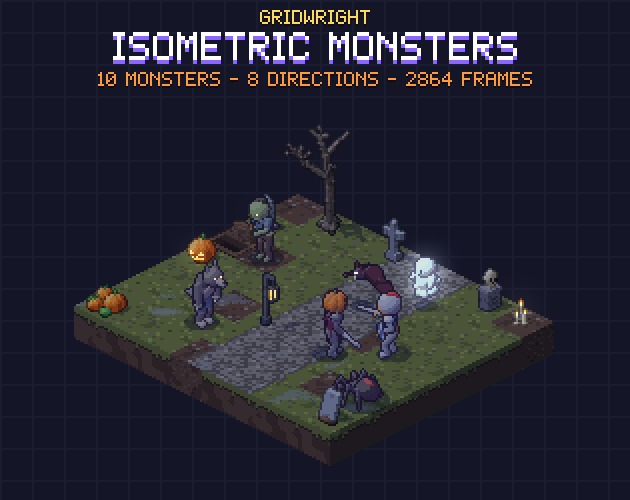
A wave is easy to read when every enemy type has its own size and way of moving. Isometric Monsters has 10 monsters in 8 directions on 64x64 cells: a small hopping slime (20x18 px in its cell), a gliding wraith (44x48 px), a heavy stone golem, a flying vampire bat, a floating ghost, a werewolf, a giant spider, a pumpkin knight, a zombie and a winged imp. Every monster has idle, move, attack, hurt, death and a spawn animation: the zombie climbs out of its grave, the slime forms out of a puddle and the golem assembles from rocks, which is a good way to start each wave at the spawn point.
- Open with one slow, simple type, so the player learns the path.
- Add a fast small type that tests whether the towers can keep up.
- Mix in fliers, which you can choose to send straight at the goal instead of along the road.
- End a wave with one big, slow enemy that soaks damage.
- Keep the same enemy types in the same roles, so players learn them.
The data matters as much as the art. Each monster's JSON gives the hit frames and the hit box for each direction, the move speed per direction (walkers match their stride, so the feet don't slide along the path), the hover height of flyers, and the fireball's spawn point for the imp. Use the move speed from the JSON as the enemy's speed on the path, and the hit box for what your towers can hit. For choosing the direction row from the movement, see 8 directions vs 4 directions for sprites.
Draw order on an isometric map
Every monster frame has its anchor on the same point, (32, 46), the centre of a ground diamond. Put each node's origin at that anchor, turn on Y sorting, and enemies walking behind a tower are hidden by it. Tall towers and walls need their origin at their base for the same reason. The packs' READMEs give the placement formula and the draw order, and our guide to isometric tilemaps in Godot 4 shows the TileSet settings for a 32x16 diamond.
Try the layout before you write the code
A map that plays badly is cheaper to fix as a picture. The Isometric Builder runs in your browser with every Gridwright isometric pack loaded, floors, walls, props, characters and shadows stacked by real heights, and exports PNG, an animated GIF, a Godot scene or a Tiled map. Lay out the path, the build spots and the goal, look at it at game size, and export the scene once the route reads at a glance.
None of these packs is a tower defense script: you write the waves, the targeting and the money. Castle & Siege has no characters and no grass or water (those are in Isometric Tiles), Isometric Monsters has no tiles, heroes or sound, and Isometric Tiles has straight ramps only.
Gridwright packs can be used in commercial games; you may not resell the files themselves. Packs released from October 28, 2026 ask for a credit: “Art by Gridwright” with a link (each pack’s LICENSE.txt says which applies). More on that in can I use game assets in a commercial game.